
Lehigh Valley Economic Development Corporation’s 2024 Annual Meeting on March 19 celebrated the region’s economic growth, while also recognizing and exploring solutions to the challenges that come with such growth.
LVEDC brought together a distinguished panel of veterans in development and planning to discuss the issues before the crowd of about 750 people at SteelStacks at ArtsQuest in Bethlehem. LVEDC convened the panel to promote collaboration on solutions to issues that stem from an expanding economy and the development it drives.
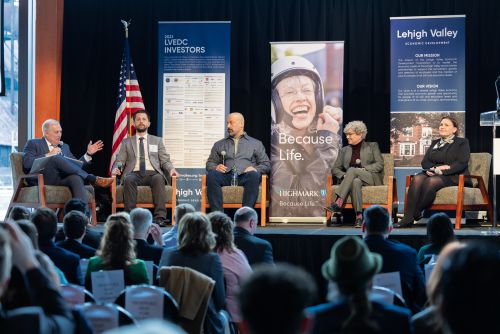
“Our work is targeted on the hard-to-do where we need to push the market and drive the development of talent. We support land use and community planning initiatives focused on strategic economic growth and the changing Lehigh Valley. The region needs to balance the equally important elements of quality of life, open space, and economic opportunity,” said Don Cunningham, President & CEO of LVEDC.
“Conversely, we need to guard against rushed and reactionary change where in addressing one issue, we create an adverse effect on critical parts of the economic ecosystem. The wisdom of decisions made today will determine the opportunity that exists tomorrow and for the next generation," he said. “Today, we have the challenges of success. That's why it's critical now that we work together, as we always have done, to meet the needs of a new era and a new time.”
Cunningham moderated a panel discussion, “The Next Chapter: Trends & Changes,” that included Adrian Ponsen, National Director for Industrial Market Analytics at CoStar Group; Jim Petrucci, President at development company J.G. Petrucci Co., Inc.; Susan Lawless, Chair of the Board of Supervisors in Hanover Township, Northampton County; and Becky Bradley, Executive Director at the Lehigh Valley Planning Commission.
The panel explored the development pressures faced by the Lehigh Valley Planning Commission, which reviews plans for development and issues recommendations, and elected municipal officials who make the final decisions. The panelists discussed the economics of development and looked at future trends in demand.
Lawless, a partner at Florio Perrucci Steinhardt Cappelli & Tipton, LLC and former chair of the township Planning Commission, said development pressures resulted in Hanover Township residents voting in a new controlling majority on the Board of Supervisors as a pushback against mega development.
People want sensible development, with appealing aesthetics and bigger buffers, she said. Things could be done better. The community knows its land is in demand, and residents want their elected leaders “to push for more.”
“But the only way we're going to do things like get bigger buffers, better buffers, maybe some meaningful, real green technology, is cooperatively,” Lawless said. “You can't make developers really do a lot of this stuff. But together we can. If they really want that parcel that's close to [Interstate] 78 and [Route] 22, they'll work with us. But we also have to be willing to work with them.”
Elected officials shouldn’t be demonized by their constituents merely for engaging in discussions with developers, she said.
Ponsen said he anticipates there will be a strong demand for industrial space and a willingness to build in the Lehigh Valley, considering its location.
“There's a lower availability right here than any of the 10 largest markets in the U.S., other than L.A.,” Ponsen said. “You can reach more people within a four-hour truck drive from here than anywhere else in the U.S. And so, we're already seeing the signs that as things start to swing back, what little available space there is now, it's going to get absorbed relatively quickly.”
Petrucci said it’s becoming “increasingly difficult” for developers to build smaller spaces in the Lehigh Valley because with the fixed costs of construction, the return isn’t there.
“If I take a project in Hanover Township of 50,000 feet or 500,000 feet, I'm going to pay basically all the same soft costs,” he said. “I’m not casting blame; it is what it is. So, the economics and the market has demanded larger buildings, for the most part.”
Petrucci said there is no question that warehouses have changed the landscape in some parts of the Lehigh Valley, including the Route 33 corridor. But he said warehouses are a necessary part of a manufacturing economy and prohibiting them could backfire on those who believe that would lessen the truck traffic.
Sixteen percent of the Lehigh Valley’s $50 billion Gross Domestic Product comes from manufacturing. More than 700 manufacturers make everything from medical devices to food and beverages to semiconductors and other technology, along with vehicles, consumer goods, and products for the military and national defense.
“I get concerned about the no-warehouse movement because our manufacturing clients all need the warehouse space,” Petrucci said. “If we move their warehouses, say down to [Route] 309, well maybe that's considered a win, but the reality of it is you have a lot more trucks on the road, they're going to be doing a lot more miles. So, I think it's somewhat self-defeating. There has to be a balance.”
Bradley said the Lehigh Valley Planning Commission is working with municipalities to coordinate zoning and create multi-municipal plans to direct new development to where it fits best.
“We have a lot of good examples of how you can coordinate,” she said.
It’s helping, she said, “but we still have a lot of work to do.”
As for office space, it’s being underutilized nationally, with workers being in the office only about half as often as they previously were, Ponsen said. Over time, that could lead to office properties being redeveloped for other uses.
Center City Allentown is bucking that trend, he said. Only about 7% of the newer office space, built since 2000, is listed as available for lease. That’s because those offices have desirable amenities and are in a desirable location near retail and restaurants. Many offices in the area are for health care and manufacturing operations, work that cannot be done remotely, he said.
“You're on a little bit better footing than the rest of the country, but it's still a very challenging market to re-lease or build office space and will be for the foreseeable future,” Ponsen said.
One type of development is sorely needed – housing.
The Lehigh Valley is facing a significant shortage of housing, 9,000 units, Bradley said.
That shortage can impact economic development efforts because for companies to expand, they need to hire more workers, and those workers need a place to live.
The planning commission will be working with the Federal Reserve Bank to develop a plan to increase the amount of market rate housing, Bradley said: “It's critical, so we don't keep having people moving farther and farther away from jobs.”
About 4,900 housing units were proposed last year, about half of them rentals, but it could take three more years for those units to be built. It’s important for the Lehigh Valley to develop partnerships to increase housing production to meet the demand, she said.
LVEDC’s 2024 Annual Meeting was presented by Highmark Blue Shield. It was livestreamed by WFMZ, view the recording here.
In addition to “The Next Chapter: Trends & Changes” panel discussion, the meeting featured a “Talent for a 21st Century Economy” panel discussion; presentations by Ben Kirshner, Pennsylvania’s first Chief Transformation Officer, and Nacho Abia, President of the Lehigh Valley Partnership and an executive at Olympus Corp.; a discussion about how Lehigh Valley businesses and organizations can participate in the region’s new branding initiative; and several videos.
Watch the videos here:
Lehigh Valley Branding
Why Lehigh Valley Branding Matters to Manufacturers and Small Businesses
Why Lehigh Valley Branding Matters for Visitor Attraction
Why Lehigh Valley Branding Matters for Talent Attraction
Why Lehigh Valley Branding Matters to Colleges and Universities
Lehigh Valley Tech Highlights
Manufacturing in Lehigh Valley, Pa.
Life Sciences in Lehigh Valley, Pa.
Made Possible in Lehigh Valley, Pa.
Cocktail sponsors for LVEDC’s Annual Meeting were Boyle Construction and Fitzpatrick Lentz & Bubba.
Gold sponsors were B. Braun Medical, Crayola, First Commonwealth Federal Credit Union, Fulton Bank, J.G. Petrucci Co. Inc., Norris McLaughlin P.A., Workforce Board Lehigh Valley, and WFMZ.
Silver sponsors were Klunk & Millan Advertising, Lehigh University, Lehigh Valley Health Network, MKSD architects, and St. Luke’s University Health Network.
Community sponsors were American Bank, Ben Franklin Technology Partners of Northeastern Pennsylvania, CLA (CliftonLarsonAllen LLP), EARTHRES, HNL Lab Medicine, OraSure Technologies, Inc., Penn Community Bank, Penn Strategies and Promus Financial.
(Photo by Marco Calderon Photography)