
During a visit to Allentown, Pennsylvania Gov. Josh Shapiro assured that many of the 10,000 workers who will receive training through a one-of-a-kind program will come from the Lehigh Valley.
Shapiro and Labor & Industry Secretary Nancy Walker visited the Allentown campus of the Eastern Atlantic States Carpenters Technical College on Aug. 30 to highlight the state’s commitment to developing the workforce of the future in the building and construction trades. 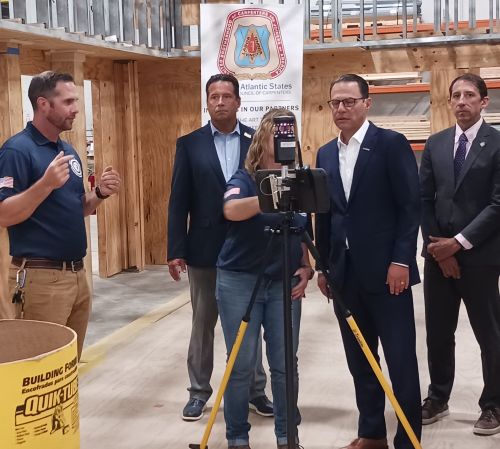
“We know that right now we need more skilled workers than ever before,” Shapiro told an audience of labor leaders, carpenters apprentices, and public officials. “And we also know that that need is only going to increase in the coming months and years.”
He was supported at the event by state Representatives Steve Samuelson, Mike Schlossberg, Peter Schweyer, and Josh Siegel, along with Allentown City Council Vice President Cynthia Mota and Allentown School Board Director Nancy Wilt.
Also attending in support were Allentown Mayor Matt Tuerk, Easton Mayor Sal Panto Jr., Northampton County Executive Lamont McClure, and Paul Anthony, Business Manager of International Brotherhood of Electrical Workers Local 375. The four are Board Members of Lehigh Valley Economic Development Corp. (LVEDC), which builds partnerships to train and develop the workforce.
“I’m glad to see this Pennsylvania budget makes a commitment to workforce development and to making sure that our residents face no barriers in getting those good jobs,” Tuerk said. “I'm looking forward to working side-by-side with the Commonwealth, with labor, and with the private sector to make smart investments in our city and region, that will make Allentown, Bethlehem, and Easton a model for mid-size cities across the country to grow our middle class and strengthen our economy.”
Infrastructure is an essential component for economic growth, and it takes skilled labor to build and maintain those assets. Construction firms need a workforce to erect the new buildings and lay the new water and sewer lines to accommodate new businesses and expansions. Workers are needed to maintain and expand the highways, multimodal centers, and airports that manufacturers rely on to get their goods to market.
Developing that infrastructure-building workforce is critical for a region that’s growing as quickly as the Lehigh Valley. It ranked second in the nation for mid-sized regions in 2022 for the number of new economic development projects. The high quality of life in the Lehigh Valley, which offers urban and rural living, 11 colleges and universities, strong healthcare, and a myriad of recreational and culture offerings, has driven the population to nearly 700,000.
The 2023-24 Pennsylvania budget, passed with bipartisan support of the Legislature, recognizes those needs with new funding and programs that Shapiro highlighted during his visit to Allentown.
The budget allocates $23.5 million for workforce training and vo-tech programs and $6 million in pre-apprenticeship and apprenticeship programming. An additional $3.5 million funds the Schools-to-Work Program to develop and expand career pathways for high school students via partnerships between schools, employers, organizations, and the Commonwealth.
And the state is dedicating $400 million in federal infrastructure funding to workforce development in what Shapiro said is the first program of its kind in the nation, which will train 10,000 new workers. Organizations performing work that is paid for with funds from the federal Infrastructure Investment and Jobs Act are eligible to receive up to $40,000 for each new worker they train.
“This is the biggest investment in workforce training in the history of the Commonwealth of Pennsylvania,” he said.
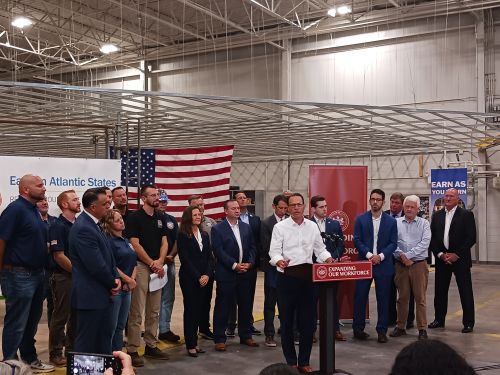 The investment was lauded by Rob Smith, Executive Training Director of Eastern Atlantic States Carpenters Technical College.
“Pennsylvania will be home to countless opportunities for working families and contractors across this great Commonwealth, creating more registered apprenticeship training opportunities that are most importantly, tied to jobs,” Smith said. “Generational construction projects, good-paying jobs will now become available to Pennsylvania workers. And the carpenters union is proudly committed to provide over 80 years of proven registered apprenticeship expertise, state-of-the-art training facilities, and earn-as-you-learn apprenticeship training programs to prepare these workers for the jobs and continue building the legacy of Pennsylvania.”
Rep. Schweyer said the carpenters’ training facility is “a model of education.”
“This is not a place for folks to simply come to learn to swing a hammer,” he said. “This is a place where people come to learn and develop those skills that they need for a real family sustaining career.”
With funding from the Infrastructure Investment and Jobs Act, Pennsylvania has a once in a lifetime opportunity to rebuild bridges and highways, update water and sewer lines, and expand broadband service, Shapiro said, but it needs the workers to complete those projects.
“I've heard so many companies and contractors and unions who've told me they're struggling to find enough workers to meet this demand, to meet this unique moment where we've got the dollars to do the work.” he said. “We've got to have the hands on the project sites to make sure it happens. If you don't invest in our workers today, we will fail to capitalize on this historic moment of opportunity.”
(Bottom photo courtesy of Pennsylvania governor's office)