
If companies want to find and keep talented employees, they need to offer more than great pay and benefits.
People want to work in a culture where they are embraced as individuals instead of as a number, where they can grow personally and professionally, and where social and civic responsibility are priorities, said talent leaders from four Lehigh Valley companies during a meeting of the Education and Talent Supply Council of the Lehigh Valley Economic Development Corp. (LVEDC). 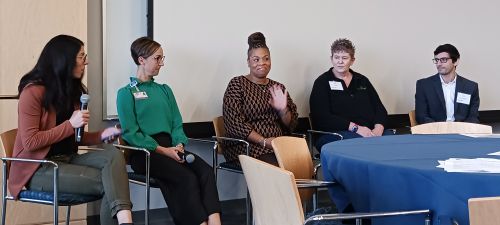
The council supports strategies that position the Lehigh Valley to attract, develop, and retain the people that employers need. On Oct. 25, the council invited employers, educators, and regional partners to Northampton Community College to learn from some of the region’s best.
“Ninety percent of the students that graduate from Northampton Community College stay in the community. We are truly educating the workforce of the Lehigh Valley. So that's what really makes this meeting so important for us and for our education partners here in the Lehigh Valley,” NCC President Dr. David Ruth said in welcoming the about 50 attendees.
Education and workforce development is at the forefront of economic development today, said Don Cunningham, LVEDC’s President and CEO.
“Whenever we're talking to prospective employers that are looking to come here, or even more importantly, our employers who are here today, their number one focus is just where am I going to get my employees? And are they going to have the right skills or at least what level of skill so we can advance and train them even further?”
Katelyn Mack, President of LINC, moderated a panel discussion about how leading companies develop their recruiting and hiring strategies.
Participating on the panel were Sarah Biggs, Assistant Vice President of Talent Acquisition at St. Luke’s University Health Network; Mindy Deeds, Human Resources Manager at Freshpet; Joe More, Talent Acquisition Leader at Lutron; and Annette Wilson, Senior Vice President of Human Resources at Shift4.
“Our big internal focus is that we don't want you to come to St. Luke's for a job, we want you to come here for a career,” Biggs said. “And that career could look different for every different person. But we have a big focus on training our people internally, and if you come here as an environmental services person and you're working 16 hours a week, and you say you know what, nursing is my calling, you can go to our nursing school for free.”
“Our commitment is once we get them in the door, and they feel connected to our mission, our responsibility is to grow them to allow them to have a really gratifying career for as long as they would like that to be,” she said.
People want to work in a place where they have ownership in the company’s performance and where they can grow their stake, Wilson said. They want a flexible work environment that allows for a good work-life balance and want to know their employer is making a philanthropic commitment to their communities.
“Social responsibility is critical,” she said. “It's not just a job, but they're also able to check off some of their social values to where they feel as though the company is focused on things that are important to them as well.”
Deeds said supervisors have to take an interest in the lives of their team members and know how to have conversations with them. Those supervisors may need training to guide them on how to have those conversations.
Companies must share professional development opportunities, but also speak with their employees about “what we can do to help them on the outside level with their commitment with their families. It's really important,” she said.
More said companies must provide job candidates with enough information so they can envision themselves working there and that authenticity is key.
“What's important from a talent attraction strategy is that you really get to connect with the particular candidate you're working with, understand their unique circumstances, their motivating factors, and really get to know them,” he said.
Also at the Education and Talent Supply Council meeting, Robyn Domber, Senior Vice President of Research at Development Counsellors International, presented data from a talent attraction survey commissioned by LVEDC.
And Nicole Radzievich Mertz, LVEDC’s Vice President of Marketing, Communications & Research, shared information about the organization’s partnership with Discover Lehigh Valley® to develop a shared logo and branding for marketing the region.
Information about how businesses and organizations can use the logo can be found here.